
Have you ever wondered why some products succeed in attracting attention at first glance, while others go unnoticed?
The answer is not only related to the product itself, but also to what customers see on its surface. A printed logo, coordinated colors, and a professional design have all become essential elements in purchasing decisions in modern markets.
Today, printing is no longer simply a process of adding a name or graphic to a product. It has become an integrated industry that plays a major role in marketing, packaging, branding, and increasing the market value of products.
With the rapid growth of the industrial sector in Egypt, particularly in plastics, glass, packaging, cosmetics, and household products, the demand for advanced industrial printing technologies has increased. These technologies must be capable of delivering high quality and high productivity to meet the requirements of the local market and export markets.
For this reason, industrial printing machines have become among the most important investments for modern factories—not only to improve product appearance, but also to increase competitiveness and strengthen the product’s presence in the market.
What Is Industrial Printing?
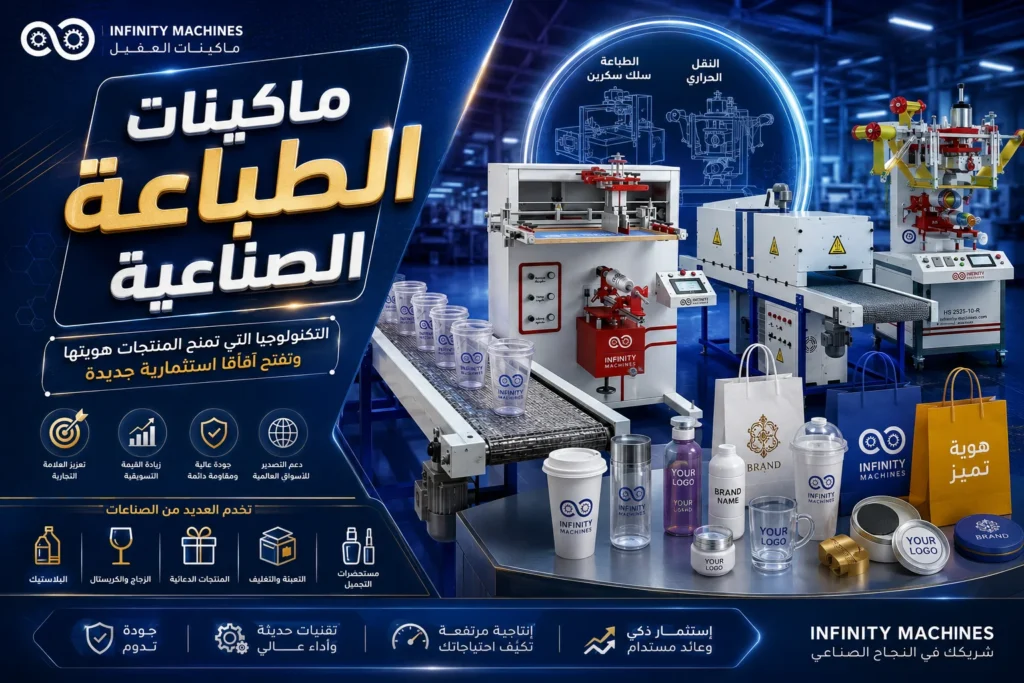
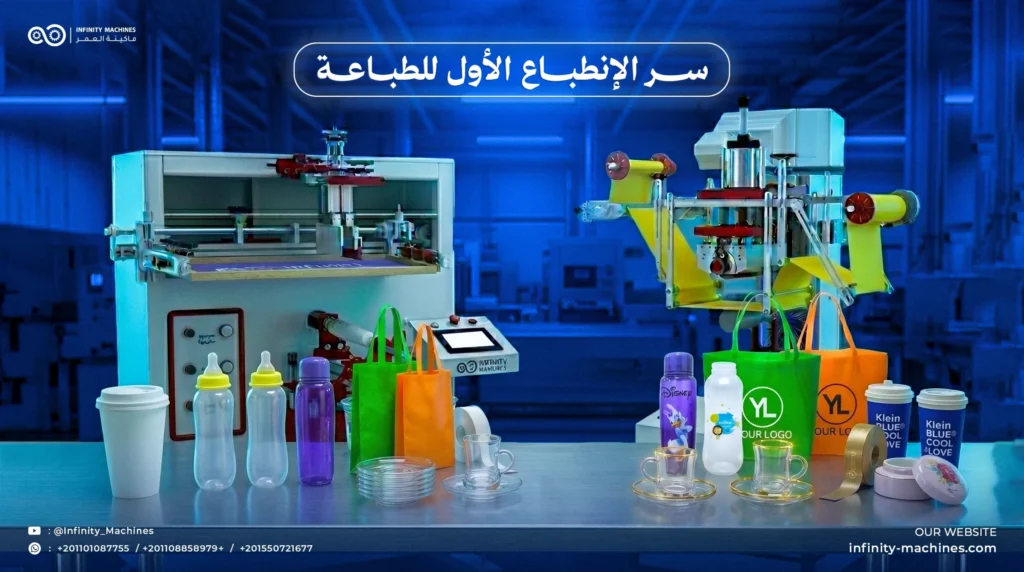
Industrial printing refers to a group of processes and technologies used to transfer text, graphics, logos, or colors onto various industrial products and materials such as plastic, glass, crystal, metal, paper, and more.
Unlike conventional printing, industrial printing is designed to operate within production lines, with the ability to achieve high production speeds, consistent quality, and resistance to daily use and external factors.
Printing and product decoration processes have developed significantly over the past decades. After once relying on limited manual methods, the industry now uses advanced industrial systems capable of producing thousands of pieces per day with the same level of quality and precision.
In Egypt, the growth of industrial printing has been directly connected to the significant expansion of the plastics, glass, packaging, and related industries. Printing has become an essential element in product success and its ability to compete both locally and globally.
Why Has Industrial Printing Become Essential for Modern Factories?
In today’s markets, having a good product alone is no longer enough to guarantee success.
Customers see the product before using it and form their first impression within just a few seconds. Therefore, industrial printing has become one of the most important indirect marketing tools for highlighting product identity and differentiating it from competitors.
Imagine two products that are almost identical in shape, material, and quality. One has clear professional printing, attractive colors, and a distinctive logo, while the other has no visual identity.
In most cases, customers will choose the product that looks more professional before even knowing its details.
That is why modern factories rely on industrial printing to achieve several objectives:
- Strengthen brand identity.
- Increase the product’s marketing value.
- Build customer confidence.
- Display product information and instructions.
- Differentiate products from competitors.
- Support export strategies and international markets.
- Increase the added value of the final product.
This highlights the importance of investing in modern industrial printing machines that provide consistent quality, high productivity, and economical operating costs.
Industries That Rely on Industrial Printing
One of the greatest advantages of the industrial printing sector is its ability to serve a huge number of different industries.
Printing is not limited to a single sector. Instead, it is used across dozens of production fields, including:
Plastic Industry
Printing is used on:
- Plastic cups.
- Plastic containers.
- Jars.
- Household products.
- Food packaging.
- Cosmetics packaging.
Glass and Crystal Industry
Printing is used on:
- Glass cups.
- Plates.
- Glass decorative products.
- Glass containers.
- Hospitality and hotel products.
Promotional Industries
Including:
- Promotional gifts.
- Customized products.
- Commercial printed products.
Packaging
Printing has become an essential part of modern packaging because it provides product information and visual identity.
This wide range of applications makes industrial printing one of the most stable and sustainable industrial sectors.
Types of Modern Industrial Printing
As industrial technology has developed, many different printing technologies have emerged, each with its own applications and advantages.
Factories choose the appropriate technology according to the nature of the product, material, and required production volume.
Some of the most common technologies include:
Silk Screen Printing
Silk screen printing is one of the most widely used printing technologies across different industries.
It works by transferring ink onto the product through a specially prepared screen containing the required design.
This technology offers:
- High printing quality.
- Excellent color stability.
- The ability to print on both flat and cylindrical surfaces.
- Compatibility with glass, plastic, and many other materials.
- Suitability for commercial and industrial production.
For these reasons, silk screen printing remains one of the most widely used printing technologies in factories around the world.
Heat Transfer Printing
This technology transfers a design from a printed medium onto the product using heat and pressure.
It is widely used when multiple-color designs or fine details are required and are difficult to achieve through direct printing.
Its advantages include:
- High precision.
- Excellent detail quality.
- Flexibility in handling different products.
- The ability to produce complex, multi-color designs.
Silk Screen Printing Machine: The Backbone of the Printing Industry
When discussing industrial printing machines, it is impossible to overlook the silk screen printing machine, which is considered a cornerstone of many modern production lines.
These machines are widely used in printing, glass, and plastic factories because of their high flexibility and ability to handle many different products and materials.
They are used to print on:
- Glass cups.
- Glass plates.
- Jars.
- Plastic containers.
- Household products.
- Promotional products.
They are also available in different sizes and configurations to meet the needs of small, medium-sized, and large projects.
Why Is Silk Screen Printing a Successful Investment?
Quite simply, because it serves a huge number of industries and customers.
An investor who owns a silk screen printing machine can provide services to plastic, glass, packaging, cosmetics, promotional-product, and other factories and businesses.
It is also an ideal starting point for those who want to enter the industrial printing sector because of its wide range of applications and the ability to gradually expand into more advanced printing technologies.
The Role of Infinity Machines in Developing the Industrial Printing Sector
As demand for industrial printing solutions continues to grow in the Egyptian market, there is an increasing need for companies with real expertise in designing and manufacturing printing machines and industrial production lines.
This is where Infinity Machines plays an important role. The company provides a diverse range of industrial printing machines designed to meet the needs of factories and investors, with the possibility of customizing many technical specifications according to the nature of the product and operating requirements.
The focus is not limited to supplying a printing machine alone. It extends to building integrated production systems that include surface preparation, printing, drying, and final curing to achieve the highest possible final-product quality.
In the next section, we will take a deeper look at heat transfer technologies, surface preparation before printing, modern drying systems, and how to choose the right printing machine for your industrial project.
How Does a Modern Industrial Printing System Work?
When many people hear the term “printing machines,” they immediately imagine a machine that prints a logo or design onto a product and then the process is complete.
However, the industrial reality is quite different.
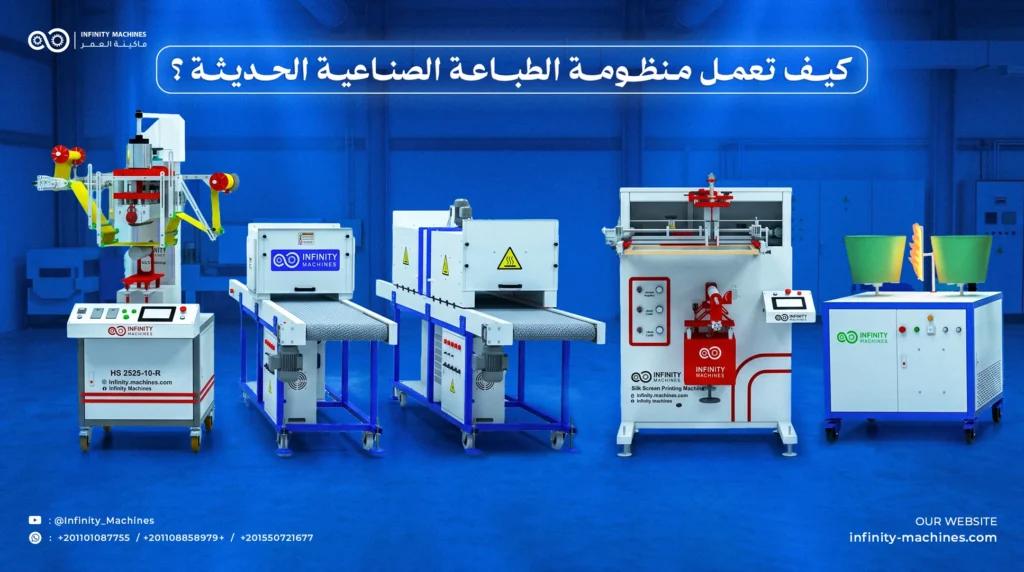
Modern industrial printing is not a single machine. It is an integrated system that starts with preparing the product surface, continues through the actual printing process, and then includes drying and curing the inks to ensure a final product with high quality, durability, and a professional appearance.
That is why modern factories rely on a series of interconnected stages that work together to achieve the best possible results.
First: Preparing the Product Surface Before Printing
One of the most common misconceptions is that any product can be printed directly simply by applying ink to its surface.
In reality, industrial materials differ significantly in their surface properties, and some require special treatment before printing to ensure proper ink adhesion and durability.
This need is particularly important with certain types of plastic that have low surface tension, making ink adhesion more difficult.
This is where the importance of surface preparation before printing becomes clear.
Flame Treatment Machine: The Step That Determines Printing Success
The flame treatment machine is one of the most important auxiliary machines used in plastic industrial printing lines.
The machine works by passing the product in front of a precisely controlled flame to perform surface treatment on the material, increasing the surface’s ability to bond with ink or color.
Although this stage may appear simple, it is one of the secrets behind achieving high-quality industrial printing.
In many cases, the problem is not with the ink or the printing machine itself, but with insufficient surface preparation before the printing process begins.
Professional factories therefore rely on this stage to ensure:
- Improved ink adhesion.
- Longer printing life.
- Resistance to peeling and damage.
- Higher final-product quality.
- Reduced waste and reprocessing rates.
For plastic factories in particular, flame treatment is an essential step before printing many plastic products and containers.
Second: Heat Transfer Printing
If silk screen printing is the backbone of direct printing, heat transfer represents one of the more advanced solutions when complex designs and fine details are required.
This technology transfers the design to the product using heat and pressure, allowing manufacturers to achieve precise results, consistent colors, and high quality.
Heat transfer machines are used in many industrial applications, particularly when products require multi-color designs or elements that are difficult to produce using conventional printing methods.
Why Do Factories Use Heat Transfer Printing?
Because some products require:
- Extremely fine details.
- Complex designs.
- Multiple colors in the same process.
- Consistent quality across all pieces.
In such cases, heat transfer becomes an ideal solution.
This technology can also handle many different materials, including:
- Plastic.
- Glass.
- Paper.
- Certain composite materials.
Heat Transfer Machines in Modern Factories
Modern heat transfer systems provide significant flexibility when handling cylindrical and flat products of different sizes.
For this reason, factories use different types of heat transfer machines depending on their production requirements.
Some machines are designed specifically for cylindrical and round products, while others are designed to handle large flat surfaces.
This variety gives investors and manufacturers the freedom to choose the system that best fits their business activities.
Third: Industrial Ink and Coating Distribution
In some applications, the goal is not simply to print a logo or design, but to create a uniform layer of ink or coating across the entire surface of a product.
This is where the automatic brush coating machine becomes important.
This machine is used to distribute a thin and uniform layer of ink or coating across different products, whether they are horizontal or vertical.
This process helps to:
- Improve the quality of subsequent printing.
- Achieve consistent colors.
- Prepare the product for additional manufacturing stages.
- Improve final finishing quality.
This stage is important in certain industries that rely on special visual and decorative effects.
Fourth: Ink Drying and Print Curing
After the printing process is completed, a stage begins that is just as important as all the previous stages.
Even the best printed design can lose its quality if it is not dried and cured correctly.
Modern industrial printing lines therefore rely on specialized drying systems to achieve the highest levels of durability and quality.
UV Drying Conveyor Systems
This technology uses ultraviolet radiation to dry certain types of ink quickly and efficiently.
It offers several important advantages:
- Fast drying.
- Increased productivity.
- Reduced operating time.
- Improved printed-surface quality.
- Reduced risk of damage during handling.
For this reason, UV systems have become common solutions in many modern factories.
Thermal Drying Conveyors
In some industrial applications, direct heat is used to dry inks and coatings.
These systems can handle various types of inks and different products.
They also allow manufacturers to control operating speed and temperature according to the nature of the product and production requirements.
Why Is the Drying Stage So Important?
Because it directly affects:
- Color stability.
- Scratch resistance.
- Abrasion resistance.
- Printing lifespan.
- Final-product quality.
Therefore, factories that prioritize quality do not consider drying a secondary step. Instead, they regard it as an essential part of the overall printing process.
How Do You Choose the Right Printing Technology for Your Project?
There is no single printing technology that is suitable for every product.
The correct choice depends on several factors, including:
- Product type.
- Manufacturing material.
- Production volume.
- Number of colors required.
- Required level of detail.
- Target market.
For example:
If you are targeting high-volume printing of plastic containers and products, silk screen printing combined with flame treatment may be one of the best solutions.
If the products require fine details, complex designs, and multiple colors, heat transfer printing may be the more suitable option.
In all cases, choosing the right machines from the beginning helps reduce operating costs and achieve a higher return on investment over the long term.
Infinity Machines: More Than Just a Machine Manufacturer
When studying the needs of different factories, it becomes clear that the real challenge is not simply purchasing an individual machine, but building an integrated production system capable of achieving the highest quality and productivity.
That is why Infinity Machines focuses on providing integrated industrial solutions covering different stages of the printing process, from surface preparation and printing to heat transfer, drying, and curing systems.
This approach gives investors and factory owners the ability to build advanced production lines that match their products and future expansion plans.
In the next section, we will discuss the relationship between industrial printing and the plastic and glass industries, the difference between printing and color spraying, and how these technologies can be integrated to create higher-value products with greater market competitiveness.
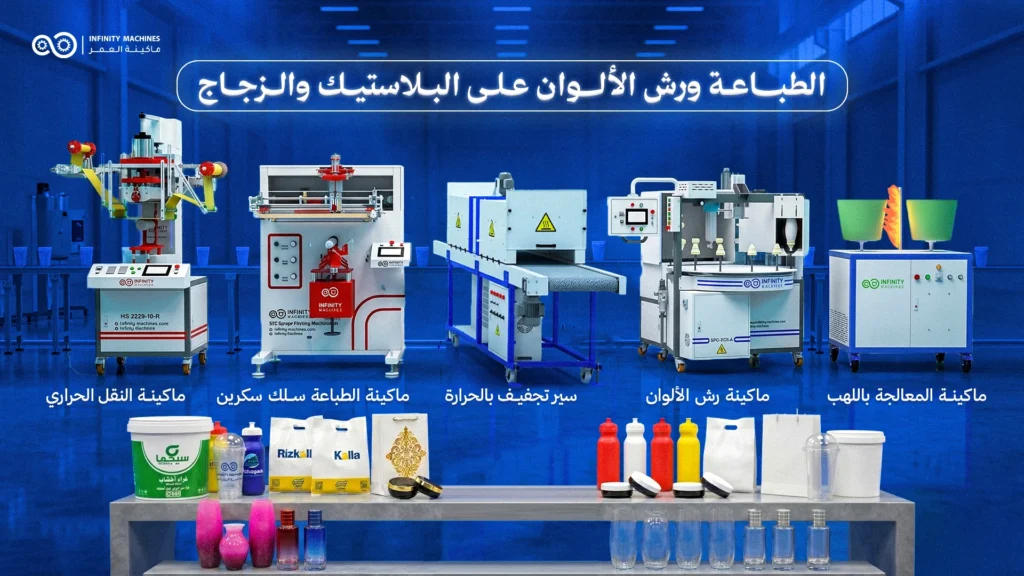
Printing on Plastic and Glass: How Does Printing Add Real Value to a Product?
After exploring the different industrial printing technologies, the most important question remains:
Where are these technologies actually used?
The simple answer is that industrial printing has become an essential part of a huge number of products we use every day, from simple plastic containers to premium glass products used in hotels, restaurants, and by international brands.
Because plastic and glass represent some of the largest industrial sectors in Egypt and the Arab region, industrial printing has become a key element in the success and increased market value of these industries.
Printing on Plastic: More Than Just a Logo
The plastic industry is one of the fastest-growing sectors in Egypt, with plastic products used across dozens of different industries, including:
- Food industries.
- Cosmetics.
- Detergents.
- Household products.
- Medical products.
- Hospitality products.
- Industrial containers.
With such a wide range of applications, plastic products are no longer simply manufactured items. They have become complete marketing tools.
A container carrying a professional logo and high-quality printing gives the product greater value and increases consumer confidence.
That is why modern factories use industrial printing technologies to add:
- Brand logos.
- Product information.
- Warnings and instructions.
- Marketing elements.
- Decorative designs and colors.
This transforms an ordinary plastic item into a finished product capable of competing in the marketplace.
Why Do Plastic Products Require Special Surface Preparation Before Printing?
One of the well-known challenges with certain types of plastic is that their surfaces do not allow inks to adhere easily.
This is why flame treatment, discussed earlier, is so important.
Through this process, the surface is prepared to receive the ink correctly, helping to:
- Improve printing quality.
- Increase abrasion resistance.
- Reduce color peeling.
- Extend product life.
This makes surface preparation an integral part of professional printing.
Printing on Glass: Turning a Piece into a Premium Product
While printing on plastic is often aimed at marketing and brand identity, printing on glass combines marketing, decoration, and aesthetic value at the same time.
For this reason, it is widely used for:
- Glass cups.
- Plates.
- Premium containers.
- Perfume bottles.
- Promotional products.
- Hotel and restaurant products.
- Household glassware.
Glass printing allows manufacturers to add logos, graphics, and colors that give products a more professional and distinctive appearance.
It can also significantly increase the product’s marketing value compared with unprinted products.
Why Is Printing on Glass Different from Printing on Plastic?
Although the ultimate objective is the same, the nature of the material is significantly different.
Glass requires specialized curing and drying systems to ensure ink adhesion and durability against repeated use, washing, and friction.
Therefore, glass printing lines usually include additional stages such as:
- Printing.
- Drying.
- Firing or thermal curing.
- Final inspection.
These stages help ensure that the printing remains intact for long periods without deterioration or loss of quality.
Printing or Color Spraying? What Is the Difference?
One of the most common questions asked by investors and factory owners is:
Do I need a printing machine or a color spraying machine?
The more accurate question is:
When should I use printing, and when should I use spraying?
This is because each technology performs a completely different function.
Industrial Printing
Printing is used when the objective is to apply:
- Logos.
- Text.
- Product information.
- Graphics.
- Specific designs.
In other words, printing transfers content, a message, or a visual identity onto the product.
Examples include:
- Printing a company logo on a cup.
- Printing a brand name on a container.
- Printing a decorative design on a glass product.
Color Spraying
Spraying, on the other hand, is used when the objective is to:
- Change the overall color of a product.
- Add color effects.
- Create a complete coating layer.
- Produce special color gradients.
In other words, spraying focuses more on the overall color of the product than on transferring information or graphics.
Why Do Successful Factories Use Printing and Spraying Together?
In reality, there is no conflict between the two technologies.
Many products go through both processes.
For example:
- The product is sprayed with its base color.
- The color is dried and cured.
- Printing is applied over the colored surface.
The result is a product that combines an attractive appearance with a clear brand identity.
This is why modern glass factories often integrate spraying, printing, and decoration technologies into a single production line.
How Can Industrial Printing Become a Successful Investment Project?
One of the key advantages of industrial printing is that it does not depend on a single industry.
An investor with professional printing equipment can work with:
- Plastic factories.
- Glass factories.
- Packaging companies.
- Food companies.
- Detergent companies.
- Cosmetics companies.
- Hotels and restaurants.
- Advertising and promotional companies.
This wide range of customers reduces the risks associated with relying on a single client or industry.
It also creates continuous opportunities for expansion as the business grows.
How Can an Investor Start in This Field?
In many cases, projects begin with basic printing machines such as:
- Silk screen printing machines.
- Heat transfer machines.
- Surface preparation equipment.
The project can then gradually expand by adding:
- Spraying lines.
- Drying and firing systems.
- Decoration machines.
- Integrated production lines.
Over time, the project can develop from a small workshop or production unit into a factory capable of serving multiple industrial sectors.
Why Is Demand for Industrial Printing Machines Increasing in Egypt?
The Egyptian market continues to experience growth in sectors such as:
- Plastics.
- Glass.
- Packaging.
- Food industries.
- Cosmetics.
All of these sectors require advanced printing solutions to keep up with increasing competition.
The expansion of Egyptian exports is also increasing the need for products with professional appearances and high quality that meet the requirements of international markets.
For this reason, industrial printing machines have become some of the most sought-after equipment among investors and factory owners looking to develop their products and increase their competitiveness.
Infinity Machines… A Partner in Building Production Lines, Not Just a Machine Manufacturer
When it comes to industrial printing, success does not depend solely on purchasing a good machine. It depends on selecting an integrated production system capable of achieving high levels of quality and productivity.
Based on this approach, Infinity Machines designs and manufactures integrated industrial solutions serving the plastic, glass, printing, decoration, and color spraying sectors.
The company provides a diverse range of printing, preparation, and drying machines that help investors and factory owners build advanced production lines suited to current market requirements and future expansion plans.
Conclusion
Industrial printing is no longer simply an additional production step. It has become an essential element in the success of modern products.
It is the means through which a product establishes its identity, increases its marketing value, and competes in local and international markets.
With continuous developments in printing, preparation, and firing technologies, investment opportunities in this sector are greater than ever, particularly with the rapid growth of the plastic, glass, and packaging industries in Egypt.
Therefore, choosing the right technology and the right industrial partner is the first step toward building a successful project capable of growth, expansion, and creating real long-term value.
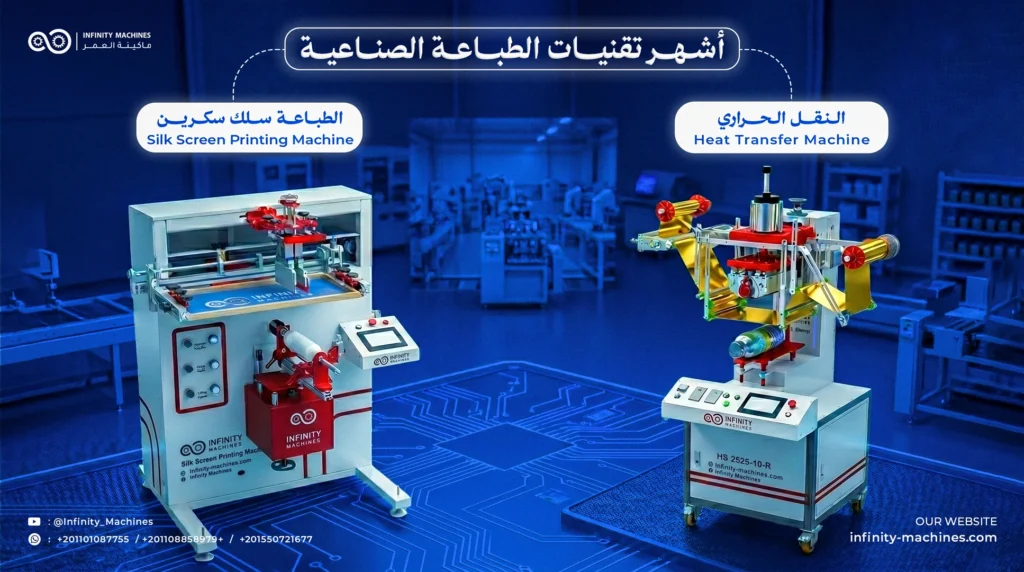
Comparison of the Most Popular Industrial Printing Technologies
When choosing the right printing machine, it is important to understand the differences between the various technologies used in factories and production lines.
| Technology | Applications | Advantages | Best Suited For |
|---|---|---|---|
| Silk Screen Printing | Plastic, glass, cylindrical and flat products | High quality, economical cost, high flexibility | Different factories and production lines |
| Heat Transfer Printing | Products requiring fine details or multi-color designs | High precision and professional results | Promotional products and specialized packaging |
| Flame Treatment | Preparing plastic surfaces before printing | Improved ink adhesion and higher printing quality | Different plastic products |
| UV Drying | Rapid drying of inks | High production speed and excellent quality | Modern production lines |
| Thermal Drying | Curing inks and coatings | Suitable for a wide range of industrial applications | Glass, plastic, and color-sprayed products |
How Do You Choose the Right Printing Machine?
Choosing the right printing machine depends on several key factors:
Product Type
Is the product:
- Glass?
- Plastic?
- Cylindrical?
- Flat?
Each type requires a different technology to achieve the best results.
Production Volume
If daily production volume is high, it is preferable to use more efficient and productive systems to reduce operating costs and increase production speed.
Design Requirements
If the design consists of:
- Simple logos.
- Text.
- Limited colors.
Silk screen printing will often be an ideal choice.
However, if the design contains:
- Fine details.
- Complex images.
- Multiple colors.
Heat transfer printing may be the more appropriate solution.
Future Expansion Plans
It is always preferable to consider the factory’s future needs rather than focusing only on current requirements.
Many factories start with one machine and gradually expand by adding preparation, drying, and additional printing systems as the business grows.
The Future of Industrial Printing in Egypt
Egyptian industry has witnessed significant development in recent years, particularly in:
- Plastics.
- Glass.
- Packaging.
- Food industries.
- Cosmetics.
As competition between locally manufactured and imported products increases, the final appearance of a product has become an influential factor in purchasing decisions.
Therefore, demand for industrial printing machines and related production lines is expected to continue growing in the coming years, as more factories seek to improve their products, enhance quality, and increase their ability to compete.
Frequently Asked Questions About Industrial Printing Machines
What Is the Best Printing Machine for Plastic?
It depends on the type of product and the required design. However, silk screen printing machines are among the most commonly used solutions for printing on different types of plastic products.
What Is the Difference Between Silk Screen Printing and Heat Transfer Printing?
Silk screen printing transfers ink directly onto the product through a dedicated screen, while heat transfer printing transfers the design using heat and pressure from a pre-printed roll.
Can You Print on Glass?
Yes. Many glass products such as cups, plates, containers, and bottles can be printed using specialized printing technologies combined with suitable firing and curing systems.
Why Is Flame Treatment Used Before Printing?
Flame treatment helps improve ink adhesion on certain types of plastic, resulting in higher printing quality and a longer printing lifespan.
Can Printing Be Combined with Color Spraying?
Yes. Many modern production lines combine color spraying and printing to create products with a professional appearance and higher marketing value.
Is Industrial Printing a Profitable Business?
Because many industries—including plastics, glass, packaging, and cosmetics—rely on printing, industrial printing is considered a promising sector offering significant opportunities for growth and expansion.
Why Do Investors Choose Infinity Machines?
Successful investors are not simply looking for a machine. They are looking for an industrial partner with the experience and ability to understand project requirements and provide suitable solutions.
With its experience in designing and manufacturing industrial machines and production lines, Infinity Machines provides a diverse range of industrial printing solutions that help factories and investors develop their products and achieve high levels of quality and productivity.
Whether you are planning to establish a new project or develop an existing factory, choosing the right technology from the beginning can help reduce operating costs and achieve a better return on investment over the long term.
Start Your Project with Infinity Machines
If you are looking for advanced industrial printing solutions or want to learn more about the best machines for your products, the Infinity Machines team can help you select the optimal solution according to the nature of your business and production objectives.
Contact us today for specialized technical consultation and to learn more about the latest industrial printing machines and integrated production lines.
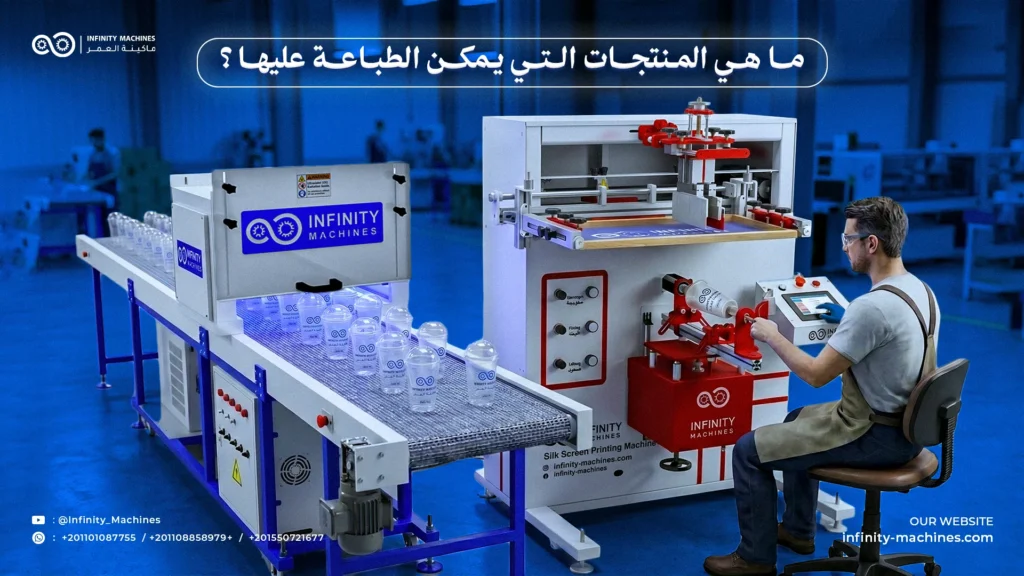
What Products Can Be Printed On?
Some people believe that industrial printing is limited to a small number of products, but the reality is very different.
With the significant development of modern printing technologies, industrial printing machines can now handle a very wide range of materials, shapes, and sizes. This has made them an essential part of many production industries around the world.
Today, industrial printing is involved in the manufacturing, development, and marketing of thousands of products used every day in homes, restaurants, hotels, stores, and factories.
Printing on Plastic Cups
Plastic cups are among the most common products that rely on industrial printing.
These products are used in:
- Restaurants.
- Cafés.
- Beverage companies.
- Events and exhibitions.
- Business occasions.
Printing applications include:
- Brand logos.
- Brand names.
- Marketing information.
- Graphics and decorative elements.
- Temporary advertising campaigns.
Printing transforms a simple consumer cup into a mobile marketing tool that carries a company’s identity in front of thousands of customers every day.
Printing on Plastic Containers
Plastic containers are among the largest sectors benefiting from industrial printing technologies.
They include:
- Water bottles.
- Juice containers.
- Detergent containers.
- Oil containers.
- Chemical containers.
- Shampoo bottles.
- Liquid soap containers.
- Cosmetics containers.
Printing is used to display:
- Product names.
- Brand identity.
- Instructions.
- Warnings.
- Usage information.
- Marketing information.
In many cases, printing quality can directly influence purchasing decisions.
Printing on Plastic Jars
Food and cosmetics manufacturers rely heavily on printed plastic jars.
Common applications include:
- Cream jars.
- Skincare product jars.
- Dietary supplement containers.
- Food jars.
- Spice containers.
Direct printing on jars gives products a more professional appearance compared with relying solely on traditional labels.
Printing on Plastic Household Products
This category includes a large number of products such as:
- Cups.
- Plates.
- Storage containers.
- Multi-purpose boxes.
- Storage products.
- Children’s products.
Printing is used to add:
- Logos.
- Graphics.
- Instructions.
- Brand identity.
This increases the marketing value of the final product.
Printing on Glass Cups
Glass cups are among the most popular products used in the printing and decoration industry.
Applications include:
- Juice glasses.
- Coffee cups.
- Tea cups.
- Hotel and restaurant cups.
- Promotional products.
Glass printing allows manufacturers to add:
- Logos.
- Graphics.
- Colors.
- Decorative effects.
This gives the product greater aesthetic and marketing value.
Printing on Glass Plates
Important industrial printing applications also include:
- Serving plates.
- Hospitality plates.
- Premium glass products.
- Products designed for hotels.
Printing is used here for:
- Decoration.
- Customization.
- Adding brand identity.
This is particularly important in the hospitality and restaurant sectors.
Printing on Perfume Bottles and Cosmetic Containers
The perfume and cosmetics industry is one of the industries that relies heavily on high-quality printing.
Printing is used to add:
- Brand names.
- Product names.
- Ingredients.
- Marketing information.
- Premium design elements.
These details help products stand out in highly competitive markets.
Printing on Food Glass Containers
Printing is used for:
- Honey jars.
- Sauce containers.
- Jam jars.
- Oil bottles.
- Premium food products.
Direct printing on the container gives the product a professional appearance and helps increase consumer confidence.
Printing on Promotional Products and Gifts
Promotional products represent one of the largest markets for industrial printing.
Common products include:
- Promotional cups.
- Souvenir products.
- Marketing gifts.
- Office supplies.
- Customized corporate products.
Companies use these products to strengthen brand visibility and communicate with customers.
Printing on Hotel and Restaurant Products
Hotels and restaurants use industrial printing to add their brand identity to many products, such as:
- Glasses.
- Cups.
- Serving items.
- Special containers.
- Promotional products.
This contributes to building a professional brand image.
Printing on Medical and Pharmaceutical Products
In some industrial applications, printing is used on:
- Pharmaceutical containers.
- Medical containers.
- Sanitizer containers.
- Healthcare supply packaging.
This is used to display the required data, instructions, and regulatory information.
Printing on Specialized Industrial Products
Printing is not limited to consumer products.
It also extends to:
- Industrial containers.
- Plastic vessels.
- Technical components.
- Specialized packaging parts.
- Engineering products.
These sectors are experiencing increasing demand for high-quality printing.
Why Are Industrial Printing Applications Continuously Expanding?
Because companies today are not only looking to manufacture products. They are also seeking to:
- Build a strong brand identity.
- Improve customer experience.
- Increase product appeal.
- Strengthen competitiveness.
- Increase added value.
For this reason, industrial printing has become an essential element in the success of many different products and industries.
With the continuous development of printing, preparation, and drying machines, the list of printable products continues to expand year after year, opening new investment opportunities for factories and entrepreneurs interested in entering this promising sector.